
Coconut Chutney
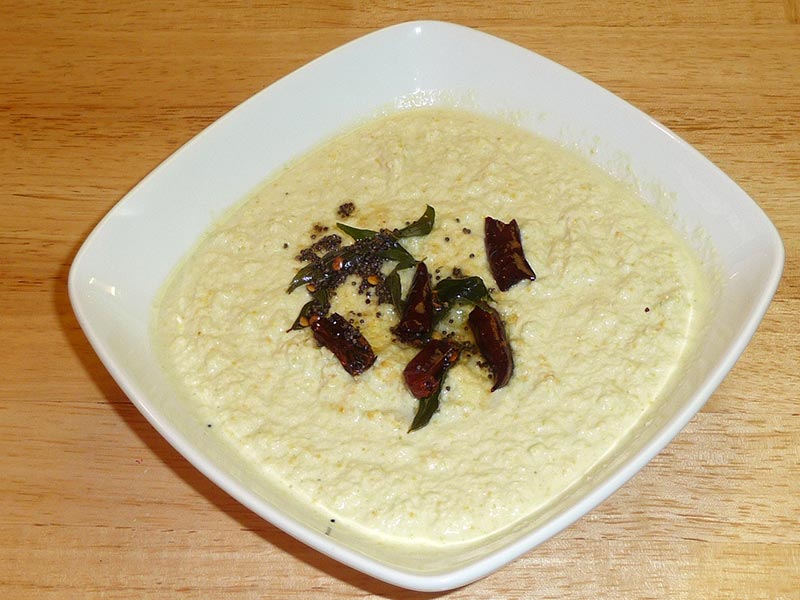
Coconut Chutney
Ingredients
- 1 cup coconut peeled and cut in small pieces
- 2 tbsp chana dal bengal gram
- 1 cup yogurt curd, dahi
- 1-1/2 tsp salt
- 2 green chilies,
- 1/2 inch ginger
- 1 tsp lemon juice as required
For seasoning
- 1 tsp oil
- 1/8 tsp asafetida hing
- 1/4 tsp black mustard seeds rai
- 2 red chilies broken pieces
- 8 curry leaves
Instructions
- Peel coconut and cut into small pieces for easy blending.
- Roast chana dal on medium heat until it is light brown in color and has a roasted aroma.
- Coarsely grind chana dal in a blender. Add yogurt, green chilies, and salt and continue blending into the paste.
- Add coconut to the paste, a few pieces at a time and keep blending. Add water, as needed, to help with the grinding. (Adding the coconut in small amounts also helps this process).
- Before removing from blender, taste chutney to adjust the salt and pepper. Use lemon juice to adjust the tang to suit your taste. Blend well.
Seasoning
- Heat oil in small pan. When hot, add black mustard seeds. When the seeds crack, add asafetida, red chilies and curry leaves.
- Pour the seasoning mixture over the chutney.
Notes
Coconut Chutney: A Refreshing and Versatile South Indian Condiment
Coconut chutney is a quintessential South Indian condiment known for its refreshing flavor, creamy texture, and versatility. Made from fresh coconut, green chilies, roasted chana dal (split chickpeas), and a blend of spices, coconut chutney is a delicious accompaniment to various South Indian dishes such as dosa, idli, vada, and uttapam.
This versatile condiment can also be enjoyed with snacks like pakoras, samosas, or even spread on sandwiches for an extra kick of flavor.
Benefits of Coconut Chutney:
- Good Source of Fibre: Coconut chutney contains dietary fibre from coconut and roasted chana dal, which helps support digestive health, regulate blood sugar levels, and promote feelings of fullness. A diet high in fibre is associated with a reduced risk of heart disease, diabetes, and certain cancers.
- Packed with Flavorful Ingredients: Coconut chutney gets its delicious flavor from a combination of fresh coconut, green chilies, roasted chana dal, ginger, and spices such as cumin seeds, mustard seeds, and curry leaves. These aromatic ingredients come together to create a tantalizing blend of flavours that enhance the taste of various dishes.
- Vegan and Gluten-Free: Coconut chutney is naturally vegan and gluten-free, making it suitable for individuals following plant-based diets or those with gluten sensitivities or celiac disease. It’s a versatile condiment that can be enjoyed by people with diverse dietary preferences and restrictions.
Variations of Chutney:
- Rhubarb Chutney: This Sweet and Sour chutney with a blend of spices tastes great and is very addictive. This is a great complement to any meal
- Date And Raisin Chutney: Using two major ingredients date and raisin this chutney is sweet and sour and is a great complement to most snacks, pakoras and appetizers.
- Mango Chutney: Mango fruit is a tricky recipe but it’s a chutney that acts as a great side order which can go along with pakoras, snacks, fries and other appetisers.
- Yogurt Chutney: A quick and easy chutney which can be prepared in no time and is made using yogurt and formed to excite the taste buds of all munchies like appetizers, snacks or pakoras.
Tips on How to make Coconut Chutney:
- Use Fresh Coconut: For the best flavor and texture, use fresh coconut instead of desiccated coconut or coconut powder. Break open a mature coconut, remove the flesh, and chop it into smaller pieces before blending with other ingredients to make the chutney.
- Adjust Spice Levels: Adjust the quantity of green chilies according to your preference for spice. If you prefer a milder chutney, use fewer green chilies or remove the seeds and membranes before blending. For a spicier chutney, add extra green chilies or include a few dried red chilies.
- Consistency Matters: Achieve the desired consistency of coconut chutney by controlling the amount of water added during blending. Start with a small quantity of water and gradually add more as needed to reach the desired thickness. The chutney should have a smooth and creamy texture, similar to a thick sauce.
- Tempering Technique: Master the art of tempering (tadka) to enhance the flavor of coconut chutney. Heat oil in a small pan, add mustard seeds, urad dal, dried red chilies, and curry leaves, and fry until the mustard seeds splutter and the dal turns golden brown. Pour the tempering over the blended chutney and mix well before serving.
FAQs about Coconut Chutney:
How long does coconut chutney last?
Coconut chutney can be stored in the refrigerator for 3-4 days in an airtight container. However, it’s best enjoyed fresh for optimal flavor and texture.
Can I freeze coconut chutney?
While coconut chutney can be frozen for longer storage, the texture may change slightly upon thawing. It’s best to consume fresh coconut chutney whenever possible for the best taste and texture.
Is coconut chutney spicy ?
The spiciness of coconut chutney can be adjusted according to personal preference by varying the quantity of green chilies used. It can range from mild to moderately spicy depending on the amount of chilies added.
Can I use desiccated coconut instead of fresh coconut?
While fresh coconut is preferred for its flavor and texture, desiccated coconut can be used as a substitute by soaking it in warm water for 15-20 minutes before blending.
With its simple ingredients, customizable variations, and easy preparation, coconut chutney is a must-have in any South Indian kitchen.
43 Responses
Leave a Reply
You must be logged in to post a comment.

T k you
I know this is not the usual coconut chutney recipe, but I really like it. I like the taste the yogurt gives to the recipe, and it is easier for home cooks to make a creamier chutney this way. It also freezes well.
Authentic South Indian versions don’t use yoghurt. Sometimes, one may a little yoghurt to tone it down if it is too hot. But otherwise, yoghurt is a strict no in a typical south Indian chutney.
Can you please share the traditional south indian chutney recipe without yoghurt. I’m interested a vegan recipe.
It very nice
thank you its really helpful your recipe.
it’s very nice
Hi Majula,
Where I live, freshly grated coconut ( whole coconut) is a challenge to get in the stores. Is there a substitute for it.Would dessicated coconut work?
I have tried this with dessicated coconut and it came out great.
When you do it with dessicated coconut do you soak it first ?
Yes soak the dedicated coconut in water before using for chutney.
Thank you for showing us how to make South Indian dishes. You are great!!! Thanks again.
Hello,
I really like your recipes.I feel they are very authentic and some really similar to how my nani used to cook.
One request:
Could you put approximate preparation time.
Thanks again..
i learned a lot thank you
Hi Aunty,
Could you tell me which Grinder you use..I cudnt find any useful ones..:)
awesome chutney:) thanks
Hi Manjula…your recipes and the way you teach them are excellent. I saw you on Youtube and had to check out this website. Fantastic job, Aunty 🙂 (I am a professional chef in Canada. I LOVE Indian food, but I don’t know how to cook much of it. Keep up the good work. Thank you!!!
Cooking Passion,I don’t think you can actually cook, maybe you are a lousy cook, and no one appreciates what you make, that’s why the ‘DUMb” and ‘STUPID’ comment.
If I don’t have chana dal on hand, could I use gram flour? If so, how much? Thank you!!!
Jen,
Gram flour will work, different texture but it will taste good I have done many times, do not forget to roast the gram flour.
Great one. Thanks for the video as well as brief explanation. Its really helpful and very easy to prepare.
Thanks Manjulaji for all your recipes!
To all comments about adding yoghurt, in typical south indian recipe (from Karnataka or tamil nadu), we add a little tamarind to the chutney. This gives the sour taste and yet keeps the chutney thick (getti chutney or thick chutney). Sometimes you may even find a small brown piece of tamarind while eating at a restaurant!
Adding yoghurt instead of tamarind seems new, I tried it out and it tastes great!
adding little bit of hing,little cilantro a spoonful of split gramdhal with little tammarind instead of yogurt will taste better.It is optional if u add little pudina while grinding .This is thee typical south indian chutnet. TRY THIS OUT Mummmm it is yummy
Vidyaji,
would like to learn more recipes from you, could i have your E-Mail address.My E-mail ad is bckb18@yahoo.com.
Thank you
Manjula, may I adopt you? Just made your chutney and it is out-of-this-world awesome! I never thought I could get so enthusiastic about coconut chutney. I guess there is a first time for everything. Thank you for sharing your amazing gift.
I also add yoghurt to coconut chutney to get a slightly sour taste and it comes out very much like the chutney found in south indian restaurants.
Let me thank Manjula ji for sharing such nice recipies. I have learnt so much from her. and also recently I had this programme to attend and I prepared Gulab Jamuns from Manjula ji’s recipe and it came out really nice and everyone liked them. So thanks again to her for the recipe.
You can be still sensible to call a recipe dumb if it doesn’t taste good… but so far Manjula ji has a track record of very palatable recipies so please check your words before commenting. A recipe is not dumb just because it was not cooked your way.
To Jaya and primarily to Cooking Passion:
Jaya – I am thinking that your response about the coconut chutney was being geared and directed towards “Cooking Passion’s” comments and that you were trying to be way more politically correct than I am going to be “BUT” I have to say that I think it’s just so rude of this person to come onto someone else’s website (not even their own) and call Manjula’s recipe STUPID.
How RUDE of them to do so and if this person had any polite manners or any idea of what is right or courteous then they would come back here and apologize to Manjula immediately.
First and foremost, this is HER website and people need to know that Manjula isn’t doing this for herself – she’s spending all of her own time when she could be doing anything else – out of the kindness of her heart and also so that others may learn. She is not doing it to be torn down by others, to have her recipes called STUPID by others or to have people complain about how she conducts her contests.
If COOKING PASSION actually had any “cooking passion” they would know and understand that recipes are meant to be played with and are to be experimented with by the many different people who try them. Yogurt might not be a traditional component or ingredient in coconut chutney but then again, how many different millions of recipes are out there for any single given dish or recipe in this world. Some of the best recipes or ideas have come about by people who experiment and try different things. No one has to be so rigid in their approach. I say to those people who make comments like Cooking Passion’s – that if they don’t like the way that Manjula ji posts or writes a certain recipe – to say nothing if all they are going to do is leave rude comments. Either that or start their own blog to see if they can come anywhere close to being the international success that Manjula’s Kitchen is.
I’m sorry that I sound so mean but I can only imagine how Manjula feels when she tries to do so much good for everyone and then she comes on here and sees comments that her recipes are stupid. She doesn’t deserve to be treated with such disrespect EVER.
I made a huge mistake by using the word STUPID when actually the word used was DUMB. My mistake and apology….
Yogurt in the coconut chutney is not traditional – we all know that (especially the south Indian posters). I think it’s being added to give the chutney a creamier texture. Grinding coconut into the very fine texture that is needed for this chutney is not easy with the electric blenders. It grinds it pretty well, but not to the point of fineness for chutney.
Adding the yogurt helps to bind all of the coconut together so the consistency is better. It’s not traditional, but it’s sort of a way to “make do” and get the best results under the circumstances.
This recipe is dumb. Manjula should call this variation of the south indian.
I know of a south indian aunty who also adds yoghurt to the coconut chutney she makes and must say , its spectacular.
To say a recipe or a modification to it as dumb is in my opinion “dumb” 🙂
To each his/her own.If you don’t like it, don’t make it – simple!
I totally agree with u surbhi…..this cooking passion person is the one who is dumb……i have been using many of manjulaji’s recipes…all have come out superbly….they r so simple and easy as well as tasty….calling one of her recipes dumb in itself is dumb….if a recipe does not suit a person he/she just need not make it……it would be better to avoid making such stupid comments on such a popular website.
Thank you Aunty
your all recipes are excellent and i alwayas try your new recipes,please tell me about your mixer blender,that is great,has grinded chana dal very fine.
thank you
hello manjula ji… can u pls tell which is the good mixie can use for chatney or which mixie ur useing ’cause in my mixie need to put lot of water for make chatney.so which is the good mixie for use & dry grinding also.
Neeta and to those asking about a good blender for chutneys and dry grinding:
I just purchased a K-Tec blender at Costco after I saw them doing a special events promotion there for that product. It happens to be the exact same blender that Starbucks uses for all of their coffee drinks and blending. I absolutely love it and if I hadn’t have seen it for myself, I might not believed all that this blender could do. I literally watched the demonstrator take a cup of dry uncooked basmati rice and grind it into rice flour / powder. I haven’t even taken it out of the box yet because I just purchased it yesterday but I can’t wait to use it. It will be perfect for grinding everything from dals and rice for idli to chutneys and everything in between. I watched the gentleman put a carrot, chilis, cilantro, greenpepper, cheese and spices along with a cup of tap water into the blender. He hit the button for soups and it literally blended everything and with the soup function, the heat and friction from the blades produced a very good hot soup that you could pour right into your dish. It comes with a book of recipes but for the Indian household – I see this being so much easier to use and to clean then a traditional mixie. Very easy to clean and comes in a bunch of different colors. It looks nice enough to leave on your countertop as well. Buying it from COSTCO gave me a 7 year warentee as opposed to a normal 3 year one. They only have this promotion various times throughout the year there but you can purchase on line from Amazon someone told me – it’s just that the warentee won’t be for as long. It is a little bit pricey – it was $387 before taxes but well worth every penny after seeing all that it can do! They even demonstrated that it can grind a wooden broom handle into wood chips – not that I’d try that at home but WOW!!
Channa Daal and yogurt? Never tried before! Will try soon!
I have never used channa daal and yogurt ! will try
Hi Manjulaji
I have never used Yoghurt in coconut chutney before. In Mangalore and
Karnataka we make a separate yoghurt chutney which has no coconut.
Must try your unusual version.
thank you for this chutney
Thanks a lot Aunty. I was really waiting for this, as I just made my Rava Idli yesterday after watching your Video 🙂
BTW, is the coconut raw (doodhiya) or the Gola?
Regards
-Sindhu
thank u aunty so so much i was waiting for this:) u r gr8
can we eat this chutney with dosa?
thanks
nupur
Yeah, I too have not heard of adding yogurt to chutney. I’m sure it will be delicious, ‘cos one can never go wrong with Manjulaji’s recipes.
Chutney looks good….but adding yogurt to coconut chutney is sounds new to me…It doesn’t happen in my state [Tamil Nadu]……but will surely try this…